Palmetto State Final Set Between White, Sposa at Baltimore C.C.
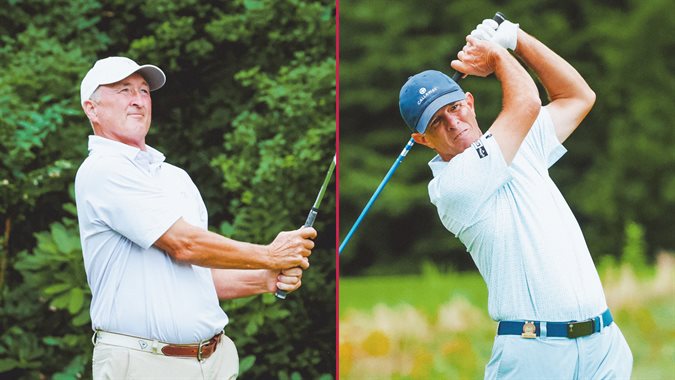
It will be an all-Spartanburg, S.C., championship match at the 71 st U.S. Senior Amateur at Baltimore Country Club’s East Course. After winning a pair of matches on Wednesday, 2023 U.S. Senior Amateur champion Todd White, 58, and Mike Sposa, 57, will square off in Thursday’s 18-hole championship.
Each are past victorious USA Walker Cup Team competitors; White in 2013 and Sposa in 1991. The two squared off in the opening round of match play a year ago at Oak Hills Country Club, in San Antonio, Texas, with Sposa prevailing en route to the semifinals, losing to eventual champion Michael McCoy.
But their path to the final wasn’t easy. White eliminated 1996 U.S. Amateur Public Links champion and 2010 U.S. Mid-Amateur runner-up Tim Hogarth, 60, of Northridge, Calif., 2 and 1. Sposa won by the same margin in the semifinals over Hogarth’s good friend and fellow Cal State Northridge alum, Corby Segal, 55, of Santa Clarita, Calif. Segal, who caddies for PGA Tour Champions member Charlie Wi, was making his championship debut.
White, who also won the 2015 U.S. Amateur Four-Ball title with current USA Walker Cup captain Nathan Smith, advanced to the semis with a 1-up victory over Brendan Hester, of Singer Island, Fla. Hogarth, meanwhile, ousted 2019 U.S. Senior Amateur champion Bob Royak, of Alpharetta, Ga., 4 and 3, in the quarterfinals held on Wednesday morning.
White wasted little time taking control of the semifinal, winning the first two holes with pars. Hogarth answered with a birdie on No. 4, but White regained a 2-up advantage one hole later. On the par-4 fifth, Hogarth found himself lying four and conceded White’s next shot, which would have been for birdie.
Hogarth continued to chip away, winning No. 6 before tying the match with a par on the eighth. White, a high school history teacher and golf coach, responded after the turn, winning No. 10 with a par before a birdie on the par-4 12th pushed his advantage back to 2 up.
“Got to give Tim credit,” said White of Hogarth. “He hung in there when he was 3-down. He fought it back. It's just a thrill to be in the finals again.”
With White 3 up through 14, the end appeared to be in sight. Hogarth, however, had other plans. He won Nos. 15 and 16 to trim White’s advantage to 1 up with two holes remaining.
Prior to the semifinal, Hogarth had not needed to play Nos. 17 or 18 in match play. White, meanwhile, had played the 17th in every match this week, including birdies against Rick Stimmel in the Round of 32 and Brian Quackenbush in the Round of 16.
That experience paid off. White delivered another birdie on No. 17, to close out a 2-and-1 victory and earn a spot in Thursday’s championship match.
In the second match of the afternoon, Sposa and Segal traded early mistakes before Segal capitalized on a Sposa bogey on No. 3 to draw first blood.
Sposa had returned to the semifinals earlier on Wednesday with a 1-up victory over Georgetown, Ky., native Tony Wise, winning Nos. 16 and 17 before closing out the match on the 18th green.
The South Carolinian found his groove against Segal on the par-4 seventh, winning three consecutive holes to seize control of the match. The run was highlighted by a 35-foot birdie putt on the difficult par-3 ninth. Segal answered with a par on No. 10 to cut into Sposa’s advantage. The pair traded pars before Segal tied the match on No. 14 after a Sposa bogey.
Sposa didn’t blink, winning No. 16 with a par before rolling in a long birdie putt on No. 17 to close out the match.
The par-3 17th has treated Sposa particularly well this week. He made a hole-in-one there in the opening round of stroke play, a birdie to win the hole against Michael Ketcham in the Round of 32 and another birdie in Wednesday morning’s quarterfinal against Wise. His latest birdie on the hole secured his spot in Thursday’s championship match.
“It's funny, too, because in the practice round I came up short,” said Sposa of the hole that measured 168 yards on Wednesday. “I think got my focus on what it was actually playing. I think that was a benefit for me coming up short in a practice round, because, yeah, I improved on that greatly.”
For Segal, the semifinal lacked the same drama as his remarkable morning comeback. Mark Small, of Frankfort, Ill., won six of the first seven holes of their quarterfinal to build a commanding 6-up lead. Segal chipped away before winning four straight holes from Nos. 14-17 to tie the match. He then got up and down from a greenside bunker on No. 18 to force extra holes and completed the comeback on the 20th when Small missed a short par putt.
Remarkably, Segal, an avid poker player, pulled off one of the greatest 18-hole comebacks in USGA history without making a single birdie. Call it the golf equivalent of winning a big pot with a bluff. Even more remarkably, he left Baltimore Country Club on Wednesday without a birdie in 37 holes.
What’s Next
Thursday’s 18-hole championship match will commence at 7:30 a.m. EDT. Admission is free, and spectators are encouraged to attend.
Notable
- Both finalists are exempt into the 2027 U.S. Senior Open at Oak Tree National, in Edmond, Okla, and next month’s U.S. Mid-Amateur at Sand Valley Resort in Nekoosa, Wis. They also receive spots in the 127th U.S. Amateur at Oak Hill Country Club outside of Rochester, N.Y. Thursday’s champion also is exempt into the 2027 U.S. Mid-Amateur at Jupiter Hills Club, in Florida, and the 2028 U.S. Amateur at Whistling Straits in Wisconsin.
- The two semifinal losers, Tim Hogarth and Corby Segal, each received bronze medals and are exempt into the next two U.S. Senior Amateur Championships at Seattle (Wash.) Golf Club and Biltmore Forest Country Club, in Asheville, N.C.
- Both semifinal matches featured a player playing with a caddie and player without a caddie. Segal, playing in his 17th USGA championship, had his 17 year-old son, Dallas, on the bag. Hogarth had a long-time friend on the bag.
- Segal and Hogarth share a long history of friendship together. They both played college golf at Cal State Northridge and were U.S. Amateur Four-Ball partners at the 2017 championship held at Pinehurst.
- The two Spartanburg titans, Sposa and White, faced each other in the Round of 64 last year. Sposa is an equipment representative for Callaway Golf. He won the 1998 Boise Open on the Korn Ferry Tour and made 174 PGA Tour starts before taking a hiatus from the game and regaining his amateur status.
- All four semifinalists are reinstated amateurs. Only Sposa played on the PGA Tour. White qualified for the 1995 U.S. Open as a professional. Sposa has qualified for two U.S. Opens: 1997 at Congressional C.C. and 2001 at Southern Hills C.C.
- The semifinal matches were delayed after a classic late-
- If White were to win on Thursday, he would be the 15th multiple-time champion of the U.S. Senior Amateur, the first since 2012 when North Carolinian Paul Simson did it.
- Coincidentally, White will have faced two past Walker Cup competitors in the championship match. He beat 1995 Great Britain & Ireland competitor Jody Fanagan in 2023 at Martis Camp.
About the USGA
The USGA is a mission-based golf organization whose purpose is to unify the golf community through handicapping and grassroots programs; to showcase the game’s best talent through the U.S. Open, U.S. Women’s Open Presented by Ally and 13 other national championships and our museum; to provide unbiased global governance with The R&A through the playing, equipment and Amateur Status rules; and to advance issues important to golf’s future, with a focus on driving sustainability, accessibility and inclusion. The USGA also manages day-to-day operations for the U.S. National Development Program, the country's first unified pathway for American talent, and the World Golf Hall of Fame, preserving and celebrating the legacies of the game’s greatest figures. As a nonprofit association, our work and our team are driven to act for the good of the game. For more, visit usga.org.